Effective Time Management in Business
- Juvy Ann Canto
- June 4, 2026
- Blog
- Business productivity, Business strategy, Business systems, Efficiency, Execution, Leadership, Operations, Prioritization, Team performance, Time management
- 0 Comments
T
ime is one of the most valuable resources in business.
Not because it is limited — but because once it is spent, it cannot be recovered.
Every decision, every meeting, and every task either moves your business forward… or quietly slows it down.
Yet despite this, time management is still one of the most overlooked areas in many organizations.
Teams are busy. Calendars are full. Work is constantly happening.
But productivity does not always match the level of activity.
And that is where the real problem begins.
Time management is not a personal skill — it is a business system
Most people treat time management as an individual responsibility.
A matter of discipline, focus, or personal organization.
But in a business environment, time management is not just personal — it is structural.
Because how time is used across a company determines how efficiently the entire organization operates.
When there is no structure, teams operate reactively.
They respond to urgency instead of strategy. They prioritize noise instead of impact.
And over time, this creates inefficiency that is hard to see but easy to feel.
The hidden cost of unmanaged time
Poor time management does not always show up immediately.
It builds gradually through small inefficiencies that compound over time.
Meetings that could have been emails. Tasks that are duplicated. Priorities that shift too often.
Individually, these seem minor.
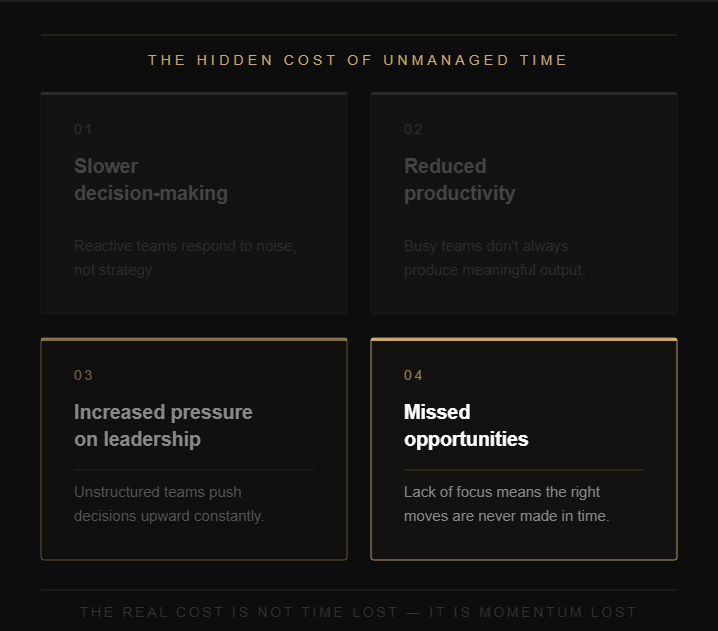
But collectively, they create:
- Slower decision-making
- Reduced productivity across teams
- Increased pressure on leadership
- Missed opportunities due to lack of focus
The real cost is not just time lost — it is momentum lost.
And in business, momentum is everything.
Why being busy is not the same as being productive
One of the biggest misconceptions in business is assuming that activity equals progress.
A full schedule does not always mean effective output.
In many cases, being busy is simply a sign of poor prioritization.
When everything feels urgent, nothing is truly strategic.
And when teams are constantly switching focus, deep work becomes impossible.
The result is a cycle of effort without meaningful progress.
The role of structure in effective time management
Time becomes powerful when it is structured.
Not controlled in a rigid way — but guided through clear systems.
Structure allows teams to understand:
- What matters most
- What requires immediate attention
- What can be delegated
- What can be removed entirely
Without structure, decisions are made in the moment.
With structure, decisions are made in advance.
And that shift alone transforms how efficiently a business operates.
Why prioritization is more important than effort
Many teams work hard but still struggle to see results.
Not because they are not capable — but because their effort is not directed correctly.
Effective time management is not about doing more tasks.
It is about focusing on the right tasks.
When priorities are unclear, even high effort leads to low impact.
But when priorities are aligned, even simple actions create strong outcomes.
How structure changes team performance
When time is managed properly at a business level, something important changes.
Teams stop reacting and start operating with intention.
Meetings become more focused. Tasks become more aligned. Communication becomes clearer.
Instead of constant urgency, there is direction.
Instead of scattered effort, there is coordination.
And that is when performance becomes consistent instead of unpredictable.
Time management is ultimately about clarity
At its core, time management is not about tools or techniques.
It is about clarity.
Clarity in what matters. Clarity in what does not. Clarity in how time should be spent to support business goals.
Without clarity, time is easily wasted.
With clarity, time becomes a strategic advantage.
Time is either managed — or it manages your business
Effective time management is not about doing more in less time. It is about creating clarity in how time is used across your business.
When time is structured intentionally, teams operate with focus, decisions become faster, and execution becomes more consistent.
But when time is unstructured, even strong teams become reactive instead of strategic.
The difference is not effort — it is system.
Let’s turn time into a business advantage
At Strategica, we help businesses build structured systems that improve focus, reduce inefficiencies, and create better execution across teams.
We focus on aligning priorities, simplifying workflows, and creating clarity in how time is used — so your business operates with intention, not urgency.
Because when time is structured correctly, productivity stops being a daily struggle and becomes a predictable outcome.
Let’s build a system that improves how your business operates
If your team is busy but not productive, or if priorities keep shifting without clear structure, it may be time to rethink how time is managed inside your business.
We help you create practical systems that improve efficiency, clarity, and overall performance.
👉 Let’s turn time into a structured advantage for your business.
Related Posts
- Juvy Ann Canto
- April 23, 2026
Your Website Should Be Your Hardest-Working Employee (Not Your Most Expensive Decoration)
Y our website is the only part of your business that never really switches off. It doesn’t ta ..
- Juvy Ann Canto
- May 8, 2026
Branding and Design Shape How People Experience Your Business
B efore a customer reads a single word about your business, they’ve already formed an impress ..